Work
Put a recorder on the table and the interview changes
Private investigators, detectives, journalists, insurance investigators, workplace investigators. In every job where you sit down and listen, the moment a recorder comes out, people start speaking for the record. How to keep a record without breaking the conversation, and where the law draws the line.
You are sitting across from someone. They are about to tell you what happened that night.
If you take out your phone now and press record, their eyes go to the phone. And what they say next is different.
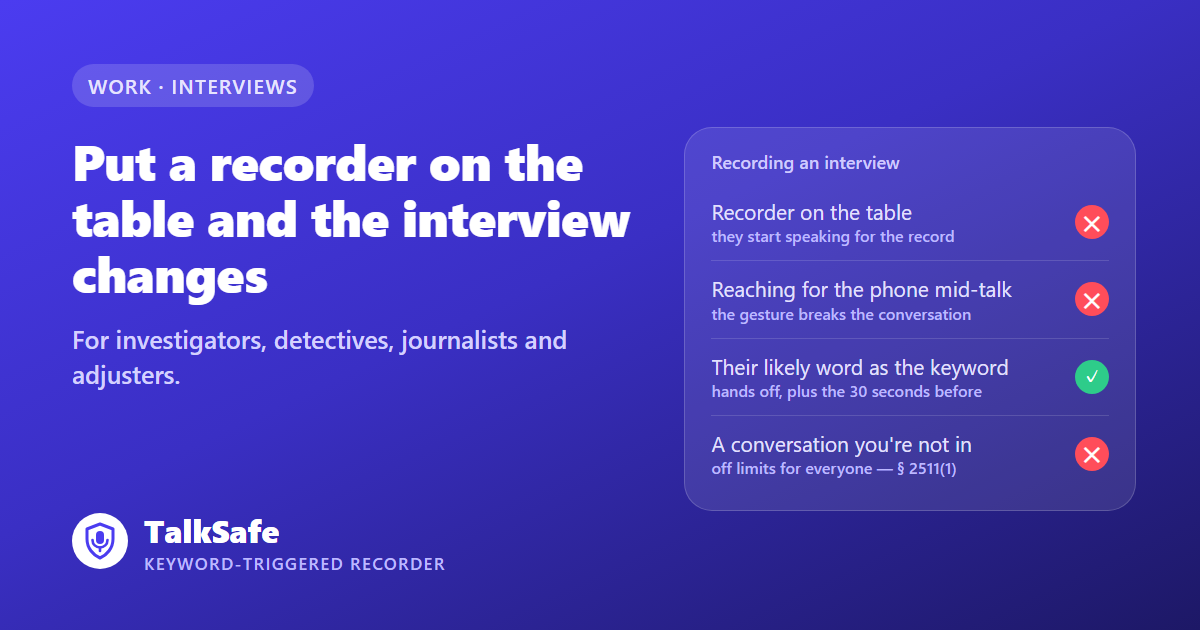
The moment a recorder comes out, people start speaking for the record. In an interview, what you need is what they said before that.
Who runs into this
More jobs depend on sitting down and listening than people realise, and most of them have to reproduce the conversation accurately later.
| Who | What conversation | Under US federal law |
|---|---|---|
| Private investigators | Witness and subject interviews | A party may record (18 U.S.C. § 2511(2)(d)); nine states require all-party consent |
| Police detectives | Canvassing, field conversations | An officer who is a party may record (§ 2511(2)(c)); policy may add rules |
| Journalists | Source interviews | A party may record; nine states require all-party consent |
| Insurance investigators | Claimant and witness statements | A party may record; nine states require all-party consent |
| Workplace investigators | Harassment and misconduct interviews | A party may record; check company policy separately |
What they share is one thing. They are all recording conversations they are part of, and they all get stuck at the same moment.
What happens when the recorder comes out
Anyone who interviews people for a living knows the scene.
The recorder goes on the table and the conversation changes character. The other person stops being someone telling you what happened and becomes someone giving a statement. Answers get shorter. Wording gets careful. The detail you came for becomes “I’ll tell you that with the recorder off.”
Leave the recorder in your bag and there is no record. Notes written up an hour later are not what they said. They are what you remember them saying.
Reaching into your pocket mid-conversation, unlocking the phone and finding the app creates the same problem. A recording that starts with a button breaks the conversation with the act of pressing it.
A keyword presses the button for you
TalkSafe is an Android voice recorder that starts recording when it hears a word you set in advance. For someone who interviews people, three things matter.
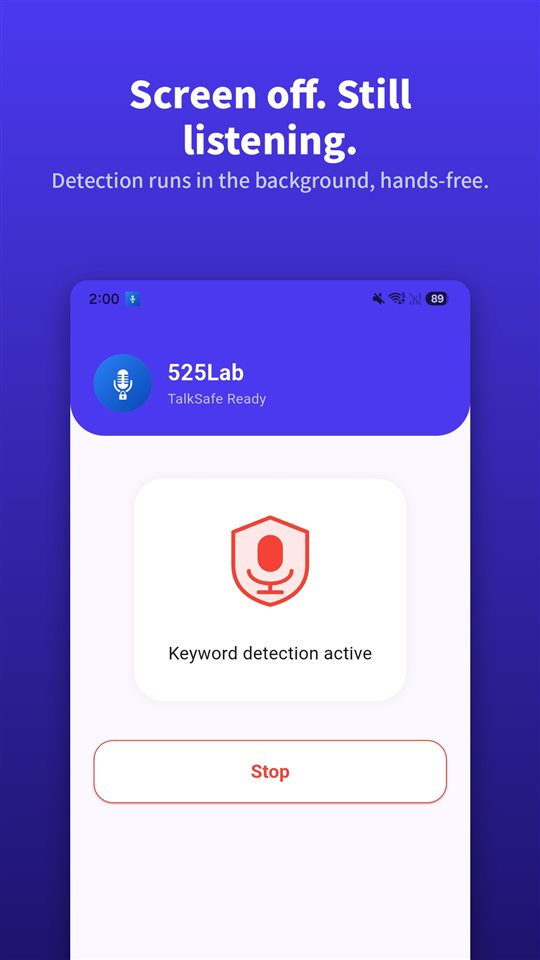
Your hands stay off the phone. It works with the screen locked, in a pocket or a bag. Nothing happens during the conversation, so the conversation keeps its shape.
The keyword can be their word. Recognition is not tied to one voice. If you know what the interview is about, set the words the other person will use when they get to it: “that night”, “the money”, “the contract”, a name. The moment the subject comes up, recording starts.
The 30 seconds before are kept. The statement that matters arrives without warning. The file starts 30 seconds before the keyword was heard, so the lead-in that produced the statement is in it too. More on why that gap exists in Why hitting record is always too late.
Where the law draws the line: your own conversations
What the app solves is recording a conversation you are in. US law draws its line in exactly the same place.
Federal law is one-party. Under 18 U.S.C. § 2511(2)(d), a person who is a party to a conversation may record it, unless the purpose is criminal or tortious. Under § 2511(2)(c), the same applies to a person acting under color of law, such as a police officer, who is a party to the conversation.
Nine states require everyone’s consent. California (Penal Code § 632), Florida (§ 934.03), Illinois, Maryland, Massachusetts, Montana, New Hampshire, Pennsylvania and Washington require the consent of all parties. Massachusetts is the strictest: its statute bans secret recording without requiring that the conversation be confidential. Which states are settled and which are contested is in the state-by-state breakdown.
A conversation you are not in is a crime everywhere. Intercepting it without a party’s consent is prohibited by § 2511(1) and punishable by a fine, up to five years in prison, or both. Leaving a phone recording in a room you walk out of, hiding a recorder in someone’s car, installing an app on someone else’s phone: none of these is a conversation you are part of, and no investigator’s licence changes that. The app is not built for that, and it should not be used that way.
Outside the US the line moves. In the UK, recording a conversation you take part in for your own records is generally not a criminal offence. In Germany (§ 201 StGB) and France (Penal Code art. 226-1), recording without consent is an offence even for a participant. More countries are in Is it legal to record a conversation you’re in?
If it becomes evidence, the original is everything
Interview records tend to end up in front of someone else — a client, an employer, a court. The first question is rarely what was said. It is whether this file is what you say it is.
Federal Rule of Evidence 1003 admits a duplicate to the same extent as the original unless a genuine question is raised about authenticity. Rule 106 lets the other side require that any other part of a statement be considered alongside an excerpt when fairness requires it. Both are answered by an untouched original.
In TalkSafe, trimming keeps the original and saves the section as a new file. If the interview took place somewhere noisy, AI noise removal cleans a copy on the device and leaves the original as it was. How to do both is in How to trim a voice recording on Android without losing the original; how courts treat recordings is in You have the recording. You still may not be able to use it.
When the interview needs consent
Not every interview is the same. In an all-party consent state, under a company policy that requires notice, or simply where asking will earn more trust, ask.
The keyword helps here too. Set “record” as the keyword and ask “Do you mind if I record this?” Recording starts at the moment you ask, so the answer is in the file. No switching the recorder on first and then asking. More in You say something first.
In short
- Taking out a recorder changes the interview.
- A keyword-triggered recording starts without touching the phone, so the conversation stays intact, and keeps the 30 seconds before.
- Under US federal law, a party may record (§ 2511(2)(d)), and so may an officer who is a party (§ 2511(2)(c)); nine states require everyone’s consent.
- A conversation you are not in is off limits for everyone (§ 2511(1)).
- If it may become evidence, keep the original untouched.
Whether you can record when you are the one being stopped or questioned by police is compared across thirteen countries in Can you record the police? Thirteen countries compared.
From the policyholder’s side of an insurance conversation, where a recording matters is covered at purchase in What the agent said is not in the policy and after a crash in No accident form has a box for what was said.
General information, not legal advice. Recording law varies by state and country, and department and company policies can add requirements. Speak to a lawyer about your own situation.
Can a private investigator record an interview they are part of?
Under US federal law, yes. 18 U.S.C. § 2511(2)(d) allows a person who is a party to a conversation to record it, unless the recording is made for a criminal or tortious purpose. Nine states require the consent of everyone in the conversation instead: California, Florida, Illinois, Maryland, Massachusetts, Montana, New Hampshire, Pennsylvania and Washington. A private investigator's licence does not change any of this.
Can police officers record a conversation they take part in?
Under federal law, yes. 18 U.S.C. § 2511(2)(c) provides that it is not unlawful for a person acting under color of law to intercept a communication where that person is a party to it or one of the parties has given prior consent. State law and department policy can add requirements, particularly for formal custodial interrogations.
Is it legal to record a conversation you are not part of?
No. Intercepting a conversation you are not a party to, without the consent of a party, is prohibited by the federal Wiretap Act, 18 U.S.C. § 2511(1), and is punishable by a fine, up to five years in prison, or both. Leaving a phone recording in a room you walk out of falls into this category.
Why does taking out a recorder change an interview?
Once a recorder is visible, people start choosing words for the record. Answers get shorter and more careful, and the detail you came for becomes something they will only say off the record. Reaching for a phone mid-conversation to start recording creates the same moment.
Is there an app that starts recording without taking out the phone?
TalkSafe is an Android voice recorder that starts recording when it hears a word you set in advance. It works with the screen locked and the phone in a pocket, the keyword is not tied to your voice so it can be a word the other person is likely to say, and the 30 seconds before the start are saved with the file.
What matters if the interview recording becomes evidence?
The original. Federal Rule of Evidence 1003 admits a duplicate unless a genuine question is raised about authenticity, and Rule 106 lets the other side require that the rest of a statement be considered alongside an excerpt. TalkSafe's trim and AI noise removal each save a new file and leave the original untouched.
What if the interview has to be recorded with consent?
Set a word from your own question as the keyword in TalkSafe, such as record. When you ask whether you can record the conversation, recording starts at that moment and the answer is in the file. That is what an all-party consent state requires.